
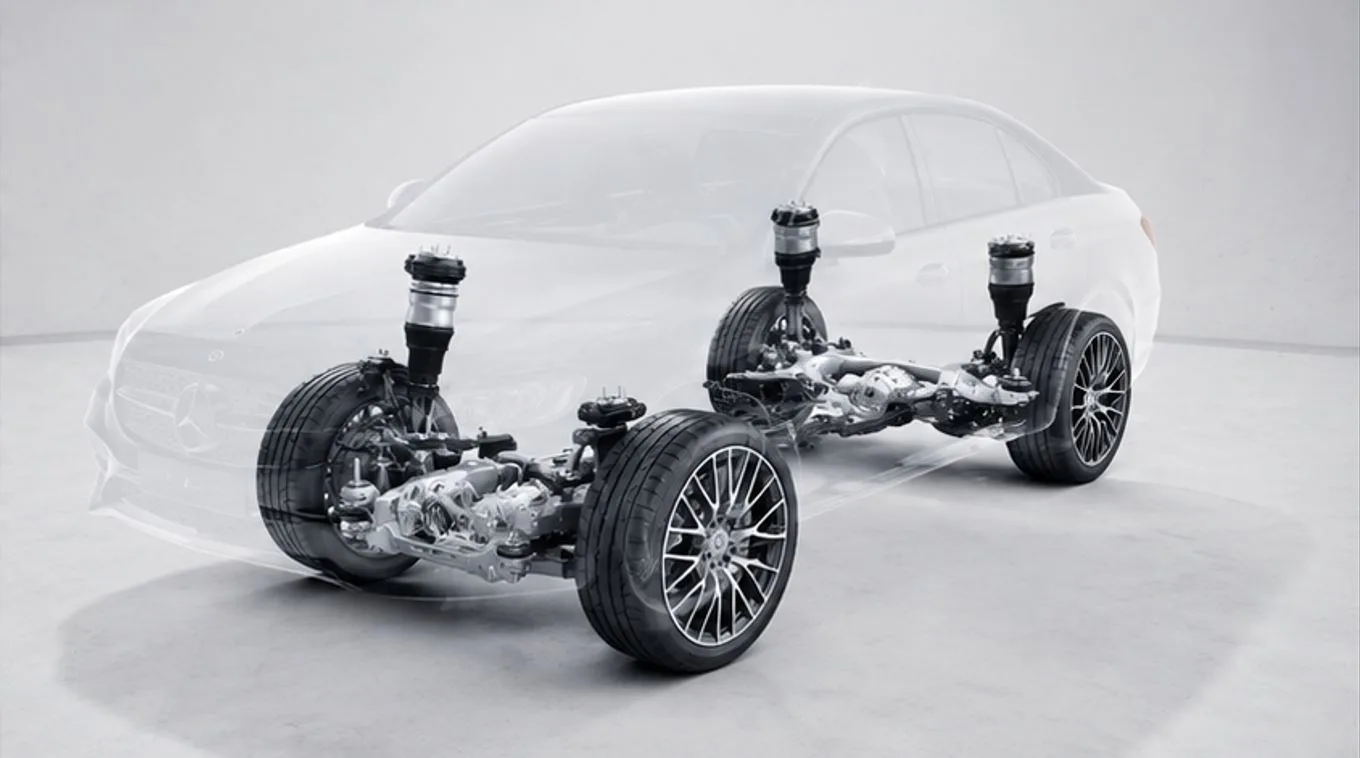
Detect Air Suspension Leaks at Home Without Special Tools or a Workshop Visit
Your Range Rover, Mercedes, BMW, or Audi doesn’t need to go to a workshop first. These simple checks take 30 minutes, cost nothing, and can save you a lot of money.
Why Air Suspension Leaks Happen More in the UAE
Air suspension was built for smooth, cool roads. The UAE is not that. From June to September, temperatures stay above 45°C for weeks. Add desert dust, long highway drives on Sheikh Zayed Road and Emirates Road, and you have a system that wears out much faster than it would in Europe or the US.
Cars like the Mercedes-Benz S-Class, BMW 7 Series, Range Rover, Land Rover Discovery, Audi Q7, and Porsche Cayenne all use air suspension. These are popular cars in Dubai, Abu Dhabi, and Sharjah — which means a lot of drivers here deal with this problem.
Quick check: Look at your car in the morning. If one corner is lower than the others, or the compressor keeps running after you start the engine, air is escaping somewhere. Both signs are free to check and take less than a minute.
What UAE Heat and Dust Actually Do to Your Air Suspension
Most car manufacturers test their parts at temperatures below 35°C. In Dubai and Abu Dhabi, summer heat goes well past that for months. Here is what happens to the system when it gets that hot:
Rubber airbags
Crack faster
Heat above 45°C makes rubber stiff and dry. Small cracks form. Air slowly leaks out
Air line seals
Shrink & harden
Hot and cold cycles make rubber lines lose their grip at the fittings. This is where many small leaks start
Valve block O-rings
Gone by year 3–4
Heat eats through the small rubber rings inside the valve block. You get random height changes when this happens
Desert dust
Wears seals down
Fine sand gets into strut seals on dusty roads in Al Ain, RAK, and Fujairah. It acts like sandpaper on rubber
If you drive in Dubai, Abu Dhabi, Sharjah, or anywhere in the northern emirates, get your air suspension checked every 20,000 km or once a year. Don’t wait for the warning light.
Signs Your Air Suspension Is Leaking
These are the things UAE drivers notice most before bringing their car in to workshops in Al Quoz, Mussafah, and Sharjah Industrial Area:
- Car looks lower on one side in the morning — especially after parking in a Dubai Marina or Downtown building overnight
- You can hear the compressor running for a long time after you start the car
- The suspension warning light comes on — very common in Range Rover and BMW
- A hissing sound near one of the wheels, usually easier to hear in the morning when it’s quiet
- The car feels wobbly at highway speed on Abu Dhabi roads or the E311
How to Check for an Air Suspension Leak at Home — 4 Simple Steps
You don’t need a workshop or any special tools. These four checks work in your building car park, your driveway, or anywhere across Dubai, Abu Dhabi, Sharjah, or the rest of the UAE. The whole thing takes about 30 minutes.
Look at the car height
Park on flat ground — any basement car park works. Step back a few metres and look at the gap between the tyre and the wheel arch on all four corners. If one corner looks lower than the rest, that’s where the air is going. Take a photo so you can compare it later.
The soap and water test
Put some dish soap in a spray bottle with water and shake it. Spray it on the rubber airbags, along the small air lines running to each wheel, and around every joint and fitting. Watch for bubbles. Bubbles mean air is coming out at that spot. This is the same trick mechanics use in Al Quoz workshops — it works on leaks too small to hear.
Leave it overnight and measure
Before you park for the night, measure the gap from the top of each tyre to the edge of the wheel arch. Use a tape measure, or just stick a piece of tape on the car door as a mark. Check it again in the morning. If the car dropped more than 1 cm anywhere, there is a slow leak. A lot of Range Rover owners in Dubai Marina and Abu Dhabi Corniche do this before deciding if they need to call a workshop.
Listen for a hissing sound
Turn the engine off and wait a minute. Walk around the car and crouch near each wheel. Listen for a soft hissing sound. Early morning — between 5 and 7 am — is the best time to do this because it’s quiet. If you hear hissing that goes on for more than a few seconds, air is leaking right now.
Where Leaks Usually Start
Problem area | Main sign | Best check method | Risk level |
Air line leak | Slow overnight drop | Soap water test | Low |
Air strut / airbag | One corner noticeably low | Visual + overnight measurement | Medium |
Valve block O-rings | Random height changes, multiple corners | Workshop pressure scan | High |
Compressor failure | Constant running, complete drop | Diagnostic tool required | Critical |
We Cover All 7 UAE Emirates
Whether you’re in Dubai, Abu Dhabi, or further up north, the same heat and dust are wearing down your suspension. We send mobile technicians across the whole country. You don’t have to drive to us.
- Dubai
- Abu Dhabi
- Sharjah
- Ajman
- Ras Al Khaimah
- Fujairah
- Umm Al Quwain
We regularly visit Al Quoz and Sheikh Zayed Road in Dubai, Mussafah in Abu Dhabi, Sharjah Industrial Area, and Al Nakheel in Ras Al Khaimah. If you prefer to drop the car off, our workshop is in Al Quoz, Dubai.
Spotted One of These Signs?
Don’t wait until the car drops completely or the compressor burns out. Message us on WhatsApp and we’ll sort a free inspection — same day in most parts of Dubai and Abu Dhabi.